
8 Most Famous Palaces in Vienna: An Imperial City Like No Other
Few cities wear their history as proudly as Vienna. For six centuries, it served as the capital of the Habsburg Empire — one of the most powerful dynasties in European history — and the palaces, gardens, and grand residences left behind are nothing short of extraordinary. Whether you're a first-time visitor trying to make sense of it all, or a returning traveller ready to go deeper, this guide takes you through the eight most famous palaces in Vienna, what makes each one worth your time, and how to experience them the right way.

1. Schönbrunn Palace — The Habsburg Summer Residence
If there is one palace that defines Vienna, it is Schönbrunn. Built in its current Baroque form under Empress Maria Theresa in the mid-18th century, this 1,441-room complex was the Habsburgs' summer court and the beating heart of the empire for generations. Napoleon used it as his headquarters. Franz Joseph I was born here and died here. Mozart performed for the imperial family in its Mirror Room when he was just six years old.
The formal gardens are a masterpiece of French garden design, climbing the hill behind the palace to the Gloriette — a triumphant colonnade with one of the finest panoramic views of Vienna. The palace zoo, the Tiergarten Schönbrunn, was established in 1752 and is the world's oldest zoo still in operation.
Inside, the state rooms are staggering in their opulence: gilded ceilings, enormous tapestries, and the famous Great Gallery where imperial receptions were held. The Millions Room, panelled with rosewood and inlaid with Mughal miniature paintings, is a cabinet of curiosities worthy of its name.

See it from the outside as part of the 3-hour Grand Royal Tour — a leisurely vintage electric car ride through Vienna's grandest imperial landmarks, including Schönbrunn and the surrounding gardens.
2. The Belvedere — Baroque Perfection and Klimt's Kiss
The Belvedere complex is, in many ways, the most visually striking palace ensemble in Vienna. Built not for an emperor but for a general — Prince Eugene of Savoy, the brilliant military commander who saved the Habsburg Empire from Ottoman invasion — it consists of two Baroque palaces set within a sweeping formal garden that descends elegantly between them.
The Upper Belvedere (1722) was conceived purely as a pleasure palace for state events and celebrations. Today, it houses Austria's most celebrated art collection, including Gustav Klimt's The Kiss — arguably the most iconic painting in the country — alongside works by Egon Schiele and Oskar Kokoschka. The Lower Belvedere served as Prince Eugene's private residence and now hosts rotating exhibitions.
The garden itself, designed by Dominique Girard, is one of the finest Baroque gardens in Europe. The central pool perfectly mirrors the Upper Belvedere's golden façade on a clear morning — a photograph practically takes itself.

The Belvedere is included in the 2-hour Platinum Complete Tour — Vienna's most comprehensive vintage electric car sightseeing experience, taking you past all the great imperial landmarks in a single elegant route.
3. The Hofburg — The Empire's Living Centre
If Schönbrunn was where the Habsburgs spent their summers, the Hofburg was where they governed the world. This vast, sprawling palace complex in the heart of Vienna's first district was continuously expanded and rebuilt over more than seven centuries, and by the time the empire fell in 1918, it covered nearly 240,000 square metres with 18 wings, 19 courtyards, and 2,600 rooms.
Today, the Hofburg functions simultaneously as Austria's presidential office, a museum complex, and a living piece of Habsburg memory. The Imperial Apartments preserve the private rooms of Emperor Franz Joseph and Empress Elisabeth (known to the world as Sisi). The Sisi Museum next door traces her extraordinary and ultimately tragic life. The Imperial Silver Collection displays the tableware used for formal Habsburg banquets with a level of detail that borders on obsessive — in the best possible way.
The Spanish Riding School is located within the Hofburg and remains one of the last institutions in the world where the classical art of equitation is still practised in its original 16th-century form. If your timing allows, attending a performance or morning training session is unforgettable.
The palace faces onto the Heldenplatz (Heroes' Square), flanked by equestrian statues of Archduke Charles and Prince Eugene. It was on this square in March 1938 that Adolf Hitler announced the annexation of Austria — a sobering reminder that these buildings have witnessed not only imperial splendour but also Europe's darkest hours.

4. The Augarten Palace — Vienna's Hidden Green Secret
Most visitors to Vienna never make it to Augarten, and that is precisely what makes it special. Tucked inside the oldest Baroque park in Vienna — open to the public since 1775 by order of Emperor Joseph II — the Augarten Palace dates to the late 17th century and was a favourite retreat of Emperor Joseph I.
Today, it is home to the Vienna Boys' Choir, who rehearse and live here. The park itself is a tranquil green escape from the city, shaded by linden trees and dotted with ceramic workshops, a porcelain factory (the famous Augarten Porcelain, in production since 1718), and the somewhat surreal presence of two enormous flak towers built by the Nazis in 1944 — enormous concrete anti-aircraft bunkers that loom above the treetops, too large to demolish safely, and now covered in vegetation.
It is that layering of history — Baroque elegance, imperial culture, and the scars of the 20th century — that gives Augarten its strange and memorable atmosphere.

5. The Liechtenstein City Palace — A Private Collection Beyond Compare
The Liechtenstein City Palace (Stadtpalais Liechtenstein) in the first district is one of Vienna's great underappreciated treasures. Built between 1694 and 1706, it was designed as the Viennese winter residence of the Princes of Liechtenstein — one of the wealthiest and most artistically sophisticated aristocratic families in Europe.
What sets it apart is the private art collection displayed inside. The Liechtenstein collection — which the family retained throughout the 20th century and never sold off — includes works by Raphael, Rubens, Van Dyck, and Rembrandt, housed in state rooms that have been meticulously restored to their original Baroque appearance. Visiting feels genuinely different from a conventional museum: less institutional, more like being invited into a palace where people actually care about what hangs on the walls.
Visits are by guided tour only, and tickets should be booked in advance.

6. The Palais Schwarzenberg — Baroque Vienna in Private Hands
The Palais Schwarzenberg stands on a rise just behind the Belvedere, its gardens forming a quiet green boundary between the third and fourth districts. Built in the early 18th century for Prince Adam Franz of Schwarzenberg and later expanded by Johann Lukas von Hildebrandt (the same architect responsible for the Belvedere), it has remained in private family ownership ever since — making it one of the few grand Baroque palaces in Vienna that was never nationalised or converted to public use.
For much of the 20th century it operated as a luxury hotel, welcoming guests including John F. Kennedy during his 1961 Vienna summit with Khrushchev. After a long period of closure for restoration, the palace reopened in 2023 with a new chapter: a high-end hotel and events venue that finally allows the public some access to its extraordinary interiors and private park.
The gardens alone, which slope down from the palace in a series of terraces with views back toward the city centre, are worth the detour.

7. The Hermesvilla — An Empress's Private World
Few places in Vienna reveal as much about Empress Elisabeth as the Hermesvilla, a romantic Neo-Renaissance hunting lodge built in the late 1880s by Emperor Franz Joseph as a private gift for his wife. Set deep in the Lainzer Tiergarten— a vast forested nature reserve on the western edge of the city that was once an imperial hunting ground — it feels genuinely remote despite being within the city limits.
Franz Joseph commissioned it as a retreat where Sisi could escape the stifling formality of the Hofburg, and the interior was designed entirely according to her personal tastes. The bedroom ceiling was painted by Hans Canon with a scene from A Midsummer Night's Dream, following the empress's own instructions. Her private gymnasium — where she obsessively exercised to maintain her famously slim figure — is preserved intact.
The Lainzer Tiergarten is now open to the public as a wildlife park, home to wild boar, deer, and mouflon. The Hermesvilla sits within it as a small museum operated by the Wien Museum — a quiet, slightly melancholy place that captures something about Elisabeth's restless, searching character that no other site in Vienna quite manages.

8. The Palais Epstein — Parliament's Noble Neighbour
Directly opposite the Austrian Parliament building on the Ringstraße, the Palais Epstein is one of the finest examples of historicist architecture in Vienna. Designed by Theophil Hansen — the same Danish-born architect responsible for the Parliament itself — and completed in 1873, it was built for the banker Gustav von Epstein as a statement of wealth and cultural ambition.
Its fate over the 20th century was turbulent: after the Epstein family was dispossessed by the Nazis, it served variously as administrative offices and Soviet military headquarters during the occupation of Vienna after 1945. It has since been restored and now serves as the administrative headquarters of the Austrian Parliament, which is why it tends to be overlooked by tourists focused on the neighbouring neoclassical colossus.
As a piece of Ringstraße architecture — the great 19th-century boulevard of ambition that Franz Joseph built to remake Vienna as a modern European capital — it deserves more attention than it typically receives.

How to See Vienna's Palaces Without Wearing Yourself Out
Vienna's palaces are spread across the city, and while many are reachable by public transport, the experience of moving between them matters as much as the destinations themselves. The Ringstraße — that magnificent boulevard of theatres, museums, and monuments that encircles the inner city — was designed to be experienced at a certain pace. On foot, you can feel rushed. By car, you miss the details.
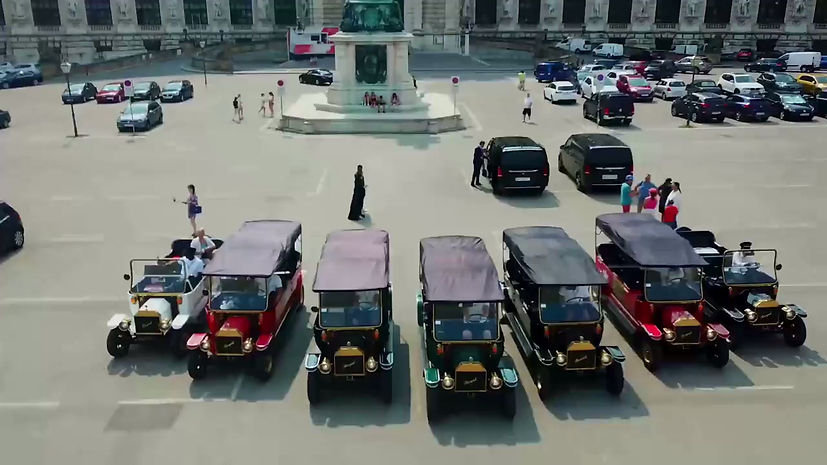
The most elegant way to take it all in is by vintage electric car — quiet, open to the air, and moving at exactly the right speed to appreciate the scale and grandeur of what the Habsburgs left behind.
The 2-hour Platinum Complete Tour covers the imperial core: the Ringstraße, the Hofburg, the Belvedere, and the great monuments of the inner city. It's the ideal introduction to Vienna's imperial geography.
The 3-hour Grand Royal Tour extends the journey outward to Schönbrunn and the surrounding imperial landscape — a fuller picture of how Vienna was shaped by six centuries of Habsburg rule.
Both tours depart from the city centre and are led by knowledgeable local guides. No rushing, no queues, no orientating yourself on a tourist map. Just Vienna, at its own pace.

A Final Thought on Vienna's Palaces
What strikes most visitors is not the gold or the grandeur — it is the density of it all. In most European cities, a single great palace is the landmark. In Vienna, there are eight on this list alone, and that barely scratches the surface of the noble palaces, garden pavilions, and imperial residences that line every major street.
That density is the product of a very particular history: a dynasty that ruled for six centuries, a city that was for long periods the political centre of Europe, and a culture that understood architecture as the most visible expression of power and permanence.
Walking (or riding) through Vienna, you are moving through one of the great open-air museums of European civilisation. Take your time with it.
Explore Vienna's imperial legacy on a guided vintage electric car tour. Book your experience at royal-ecars.com.



Comments