
Vienna's 12 Oldest Buildings: A Guide by Royal E-Cars Tours

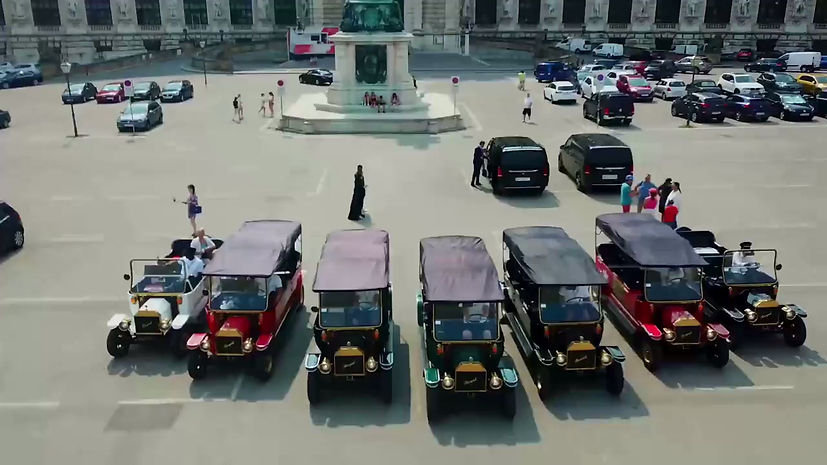
This guide to Vienna's oldest surviving buildings comes straight from Royal E-Cars Tours — Vienna's specialists in vintage electric car sightseeing tours through the historic city center. Every landmark below sits along the same cobblestone streets our tours glide through daily.
Vienna's Innere Stadt isn't just a pretty backdrop for photos — it's a layered timeline you can still walk (or, better yet, drive) through today. Beneath the Baroque facades and imperial grandeur lie Romanesque towers, Gothic chapels, and fragments of city walls that have quietly survived nearly a thousand years of fire, war, and rebuilding. For anyone planning Vienna sightseeing, understanding this hidden medieval layer completely changes how you see the city — and it's exactly the kind of story we love sharing on our electric car tours of Vienna's Old Town.
Here are Vienna's 12 oldest buildings, ranked from oldest to "youngest," and why each one deserves a stop on your itinerary.
12. Griechenbeisl — Vienna's Oldest Restaurant (1447)
Tucked at Fleischmarkt 11, the Griechenbeisl has been serving guests since 1447, making it Vienna's oldest continuously operating restaurant. The late-Gothic building actually incorporates the remains of a Babenberg-era city wall tower, with a Baroque facade layered on top in 1709. It's a perfect example of how Vienna builds onto its history rather than replacing it — a theme our guides love pointing out as we pass through this corner of the Greek Quarter.

11. Griechengasse Medieval House Complex ("Steyrerhof")
Just around the corner, the Griechengasse house complex (numbers 4, 7, and 9–11) hides Vienna's only preserved Gothic house-front, including a Gothic residential tower that was originally part of the city's defensive wall. It already appears on a map from 1483, and its first documented owner dates back to 1412. A Gothic relief on-site is dated 1476 — a rare, tangible piece of medieval Vienna hiding in plain sight.

10. Altes Rathaus and Salvatorkapelle
Duke Frederick the Fair donated this site to the city council in 1316, making it one of Vienna's earliest civic landmarks. Behind the courtyard, the Gothic Salvatorkapelle dates to the 14th century, with a striking Renaissance portal added around 1520 — a small architectural time capsule most visitors walk straight past.

9. Maria am Gestade
First documented in 1158, Maria am Gestade is one of Vienna's most photogenic medieval churches. Its Gothic choir was built between roughly 1330 and the 1360s, the nave followed from 1394–1414, and its unmistakable openwork spire was completed between 1419 and 1428. The silhouette alone makes it a highlight on any drive through the old Danube canal district.

8. Deutschordenskirche
On Singerstraße, the tower of an earlier 13th-century chapel survives, first securely documented in 1249. After fire damage, the current nave was rebuilt between 1326 and 1375 and consecrated in 1395 — a reminder of how often Vienna's medieval core had to rebuild itself from disaster.

7. Minoritenkirche
An earlier chapel stood on Minoritenplatz from 1224 until fire destroyed it. The present early Gothic church was begun in 1276 under King Ottokar II Přemysl, making it one of Austria's earliest Gothic churches — and a quiet counterpoint to the grandeur of the nearby Hofburg.

6. Burgkapelle (Hofburg Chapel)
A late-Romanesque chapel here is first documented in 1296, likely built around 1287–88 under Albert I. It was rebuilt in Gothic style between 1447 and 1449 under Frederick III, and that is the form still standing today — nestled inside the very palace complex our tours pass on nearly every route through the Hofburg.

5. Stephansdom's Riesentor and Heidentürme
Long before St. Stephen's Cathedral had its famous Gothic nave and choir, its Romanesque west facade — the Riesentor and Heidentürme — was built between 1230 and 1245 under Duke Frederick II. That's roughly a century older than the soaring Gothic sections tourists usually photograph, hiding in plain sight at the cathedral's main entrance.

4. Schweizerhof — The Core of the Hofburg
Construction of this rectangular, castellated fortress began in the 1220s–1230s, likely under Staufer influence, and was completed around 1275 under King Ottokar II. It's the oldest surviving secular building complex in the Innere Stadt — the true architectural seed from which the entire Hofburg later grew. Naturally, it's a centerpiece of our Hofburg-area tours.

3. Michaelerkirche
Construction on this late-Romanesque parish church at Michaelerplatz began around 1220–1221. The nave still stands in its original form from the second half of the 13th century, with the church's completion documented before 1252 — right across from the very square where several of our tours begin.

2. Schottenkirche / Schottenstift
Founded in 1155 when Duke Henry II Jasomirgott brought Irish-Scottish Benedictine monks to Vienna, the Schottenstift's first Romanesque church began construction almost immediately, was first documented in 1170, and consecrated in 1200. Only fragments remain today — the "Dark Sacristy" and a Romanesque chapel — since the rest was rebuilt in Baroque style in the 1630s–40s. It's a fascinating stop for anyone curious about Vienna before the Habsburgs.

1. Ruprechtskirche — Vienna's Oldest Surviving Church
Widely cited as Vienna's oldest surviving church, Ruprechtskirche's legendary founding dates to 740 AD, though it's first securely documented in 1161. Its Romanesque core — including the nave walls and a tower reassessed during 1935 renovations as dating to the second half of the 15th century — makes it, in substance, the oldest ecclesiastical building still standing in the city. Fittingly, it sits in one of Vienna's quietest, most atmospheric corners near the Danube Canal.

See Vienna's Medieval Layers for Yourself
Reading about a thousand years of history is one thing — feeling the cobblestones beneath you as you glide silently past a Babenberg watchtower or a Romanesque church tower is another entirely. At Royal E-Cars Tours, our vintage-style electric cars take you through the Innere Stadt at exactly the right pace to notice these details: slow enough to spot a Gothic relief on a housefront, quiet enough to hear your guide point out where a medieval city wall once stood.
Ready to see Vienna's oldest secrets in person? Book your Royal E-Cars Tours sightseeing tour today, starting from Albertinaplatz 2, Stephansplatz 7, or Universitätsring 4 — tours from just €60. Reserve your seat and let us show you the Vienna that's been hiding in plain sight for centuries.



Comments