
Vindobona: Tracing the Roman Empire Beneath Vienna's Streets
A guide by Royal E-Cars Tours

Long before the Habsburgs built their palaces, before the waltz and the coffee house, Vienna was a wooden-and-stone frontier fort called Vindobona. For roughly 350 years — from the 1st century AD until the Roman withdrawal in the 5th century — this was the edge of an empire: a legionary camp and civilian settlement guarding the Danube Limes, the fortified border that once stretched across half the known world. Emperor Marcus Aurelius reportedly died here in 180 AD, reputedly while writing his Meditations.
Most of the fort now lies buried under Vienna's 1st District. Graben, one of the city's grandest shopping streets, literally follows the line of the old fortress ditch — a fact most visitors striding past its boutiques never learn. But scattered through the same streets our tour routes run through every day, the Roman layer is still genuinely visible, if you know where to look. Here's a guide to Vienna's Roman Empire legacy, and where to actually stand on it.
Römermuseum (Roman Museum), Hoher Markt

The best starting point, and only a few minutes from our Stephansplatz 7 pickup point. Built directly over the excavated remains of two Roman officers' tribune houses, discovered during canal works in 1948, the museum's ground floors set the scene — Vindobona's history and daily life — before leading down into the basement, where you walk among the actual foundations. Look closely and you'll find a fragment of a tablet granting the settlement city rights, nearly two thousand years old.
Michaelerplatz

Right outside the Hofburg — and a square many of our tours pass directly by — Michaelerplatz had excavations in the early 1990s that exposed part of a Roman road and civilian dwellings, sitting at the junction of the old east-west and north-south trade routes. The remains are left open-air behind glass and railings, so you can look straight down into Roman Vienna without a ticket. It's also, fittingly, one of the loveliest stretches of the city to take in from an electric fiaker rather than on foot, with the Hofburg rising on one side and two thousand years of layered history under your wheels.
Am Hof — Fire Station Basement (Feuerwehr Wien)

A little-known one, and a nice detour if you're already exploring the inner city: the basement of Vienna's main fire station building on Am Hof preserves a stretch of the Roman-era canal system that once supplied Vindobona with water. It's not on every guidebook's list — which is exactly why it's worth a short visit.
Wien Museum, Karlsplatz

The city's main history museum devotes some of its earliest rooms to Vindobona, and to the meeting — not always peaceful — between Roman newcomers and the local population. It's a good place to see the fort in context, as one chapter in Vienna's much longer story, especially if your route already brings you along the Ringstrasse toward Karlsplatz.
Kunsthistorisches Museum

Not Vindobona-specific, but its collection of Greek and Roman antiquities is one of the finest outside Italy or Greece. If Michaelerplatz and the Römermuseum give you Vindobona the outpost, the Kunsthistorisches Museum gives you the empire it belonged to.
Schönbrunn Palace "Roman Ruin"

Worth seeing — with the right expectations. This evocative ruin in the palace gardens is an 18th-century folly, built for atmosphere rather than archaeology. It's a lovely spot on a Schönbrunn visit all the same, and pairs nicely with the genuine history covered in our post on the best palaces in Vienna if you're planning a fuller imperial-versus-Roman day out.
Carnuntum Archaeological Park (Day Trip)

About 40 km east of Vienna, Carnuntum was the much larger legionary fortress and civilian capital of the Roman province of Pannonia. It's a proper open-air site, with reconstructed villas, baths, and workshops, plus the separate Museum Carnuntinum, two amphitheatres, a gladiator school, and the freestanding Heidentor triumphal arch nearby — all part of the UNESCO-listed Danube Limes. It sits outside the usual city routes, but for anyone building a full Roman itinerary around their Vienna trip, it's the natural next stop.
Seeing It All in Order
If you want to do it chronologically: start at Michaelerplatz (free, five minutes, right under your feet), then the Römermuseum at Hoher Markt for the real depth, then — if you have a spare afternoon — Carnuntum for the full-scale version of what Vindobona once was. By the way, many buildings in the 1st District, including St. Ruprecht's Church, were also built from stone recycled straight out of the Roman ruins, so even away from these specific spots, you're often looking at repurposed Vindobona without realizing it.
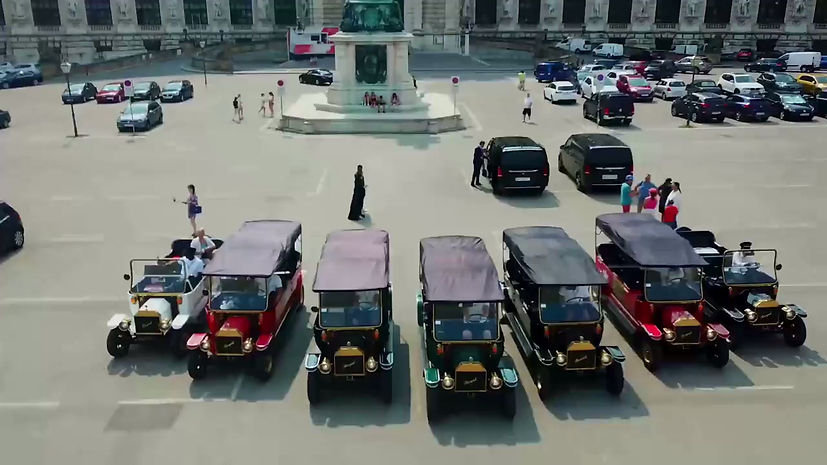
Or in the meantime, let us take care of the logistics and show you around. Our vintage electric cars trace many of these same streets — Graben, Michaelerplatz, the Ringstrasse — at a pace that leaves room to actually notice what's underfoot. Book a Royal E-Cars Tours sightseeing tour from €60, departing from Albertinaplatz 2, Stephansplatz 7, or Universitätsring 4, and see two thousand years of Vienna go by from the comfort of a convertible classic.



Comments